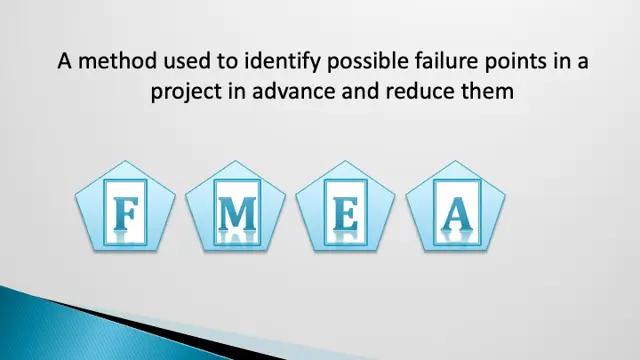
FMEA FOR SOFTWARE TESTING | Risk Analysis & Quality Assurance
York ITEST & Consulting Ltd
Identify, assess and prioritise software risks using Failure Mode and Effects Analysis (FMEA)
Add to basket or enquire
Overview
Certificates
Reed Courses Certificate of Completion
Digital certificate
- Show recruiters you've mastered in-demand skills
- Boost your CV and job applications instantly
- Share on LinkedIn to stand out from other candidates
- Transcript of completion included
Reed Courses Certificate of Completion
Digital certificate
- Show recruiters you've mastered in-demand skills
- Boost your CV and job applications instantly
- Share on LinkedIn to stand out from other candidates
- Transcript of completion included
Curriculum
This course contains
Format: 18 Videos (with subtitles and transcripts)
Duration: 0h and 58m
Description
By completing this course, learners will understand how to:
Explain the purpose and principles of FMEA
Recognise different types of FMEA
Identify potential software failure modes
Define and categorise software risks
Evaluate severity, occurrence and detection
Calculate the Risk Priority Number
Prioritise testing around higher-risk areas
Review and reassess risks following corrective action
Use FMEA to support software quality and risk management
Who is this course for?
This course is particularly suitable for:
Software testers and test analysts
Quality assurance professionals
Test managers and QA leads
Software developers
Business and systems analysts
Project and product managers
Risk and compliance professionals
Anyone responsible for software quality or risk-based testing
I also noticed a few areas that should be corrected:
The title is currently entirely capitalised.
The summary displays the duration as 0.1 hours, while the curriculum totals approximately 58 minutes.
The Reed certificate appears twice.
“Chepter 3” and “Chepter 4” should be corrected to “Chapter 3” and “Chapter 4.”
The lesson numbering could be simplified to improve readability.
.
Additionally, this training will benefit individuals looking to add risk analysis to their professional careers.
Questions and answers
There are currently no Q&As for this course. Be the first to ask a question.
Reviews
Currently there are no reviews for this course. Be the first to leave a review.
Add to basket or enquire
Course provided by


Legal information
This course is advertised on Reed.co.uk by the Course Provider, whose terms and conditions apply. Purchases are made directly from the Course Provider, and as such, content and materials are supplied by the Course Provider directly. Reed is acting as agent and not reseller in relation to this course. Reed's only responsibility is to facilitate your payment for the course. It is your responsibility to review and agree to the Course Provider's terms and conditions and satisfy yourself as to the suitability of the course you intend to purchase. Reed will not have any responsibility for the content of the course and/or associated materials.
