
Aerospace Engineering Principles
Learningidol
Independent Online Learning • Updated 2026 Content • Transparent Pricing • Digital Certificate Included
Summary
- Reed Courses Certificate of Completion - Free
- Final Exam (included in price)
- Tutor is available to students
Add to basket or enquire
Overview
Certificates
Reed Courses Certificate of Completion
Digital certificate
- Show recruiters you've mastered in-demand skills
- Boost your CV and job applications instantly
- Share on LinkedIn to stand out from other candidates
- Transcript of completion included
Reed Courses Certificate of Completion
Digital certificate
- Show recruiters you've mastered in-demand skills
- Boost your CV and job applications instantly
- Share on LinkedIn to stand out from other candidates
- Transcript of completion included
Assessment details
Final Exam
Included in course price
Curriculum
This course contains
Format: 34 PDFs, 1 Article and 1 Quiz
Duration: 2h and 4m
-
Disclaimer 01:00
-
Lecture 1: Introduction to Aerospace Engineering 06:00
-
Lecture 2: Aerodynamics and Flight Mechanics 12:00
-
Lecture 3: Aircraft Structures and Materials 12:00
-
Lecture 4: Propulsion Systems 12:00
-
Lecture 5: Avionics and Control Systems 13:00
-
Lecture 6: Aerospace Manufacturing and Maintenance 16:00
-
Lecture 7: Space Systems and Satellite Technology 16:00
-
Lecture 8: Emerging Technologies and Future Directions 15:00
-
Lecture 9: Professional Development and Career Paths 12:00
-
Assessment 09:00
Description
Aerospace engineering underpins modern aviation, satellite communications, defence systems, and space exploration. This course offers a detailed and academically grounded exploration of Aerospace engineering principles, integrating physics, mathematics, materials science, and systems engineering.
The programme begins with an introduction to Aerospace engineering, outlining its historical development and major technological milestones. Learners examine how advances in aerodynamics, propulsion, and materials have shaped the evolution of aircraft and spacecraft. Contemporary industry trends and future prospects provide context for emerging innovation.
Aerodynamics and flight mechanics form the theoretical core of the curriculum. You will study airflow behaviour, lift and drag principles, fluid mechanics fundamentals, aircraft performance metrics, and stability and control systems. These principles explain how aircraft generate lift, maintain balance, and achieve efficient flight.
Aircraft structures and materials are examined to understand load distribution, stress analysis, fatigue behaviour, and structural optimisation. Learners explore the role of advanced alloys and composite materials in enhancing strength-to-weight ratios critical to aerospace design.
Propulsion systems are analysed through examination of gas turbine engines, jet engine efficiency, and performance evaluation. Emerging propulsion technologies, including hybrid and electric systems, are introduced to highlight innovation trends.
Avionics and control systems modules explore navigation technologies, communication systems, flight control mechanisms, and the integration of autonomous systems. Learners gain insight into the electronic and computational systems that support safe and precise flight operations.
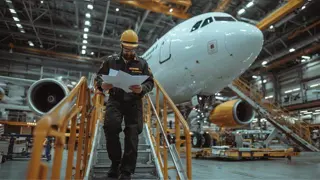
Aerospace manufacturing and maintenance modules examine production processes, quality assurance protocols, maintenance strategies, and regulatory compliance frameworks. Understanding manufacturing precision and safety standards is essential to aerospace reliability.
Space systems and satellite technology introduce fundamentals of orbital mechanics, satellite design, launch vehicle systems, and mission planning. Learners examine how spacecraft are engineered for extreme environmental conditions.
Emerging technologies such as advanced materials, electric propulsion, and commercial space ventures are explored to illustrate future directions in Aerospace engineering. The course concludes with professional development topics, ethical considerations, and industry career pathways.
Throughout the programme, Aerospace engineering is presented as a highly technical discipline grounded in scientific analysis and systems integration. Structured assessment ensures learners demonstrate comprehensive theoretical understanding.
Who is this course for?
This course is suitable for:
Students interested in Aerospace engineering and aviation
Learners preparing for further study in engineering disciplines
Technology enthusiasts exploring flight and space systems
Professionals seeking foundational aerospace knowledge
Individuals interested in space systems and satellite technology
It is ideal for those seeking structured academic insight into aerospace principles without pursuing regulated engineering certification.
Requirements
There are no formal academic prerequisites for enrolment. Basic knowledge of mathematics and physics is recommended to engage effectively with technical concepts.
Access to a reliable internet connection and suitable device is required for on-demand study.
A commitment to engaging with Aerospace engineering principles, completing the assignment, and sitting the final online exam is essential for successful completion.
Career path
Aerospace engineering knowledge may support progression into engineering support roles, manufacturing coordination, maintenance planning assistance, technical documentation roles, research support positions, or further academic study in aerospace or mechanical engineering disciplines.
Questions and answers
There are currently no Q&As for this course. Be the first to ask a question.
Reviews
Currently there are no reviews for this course. Be the first to leave a review.
Add to basket or enquire
Course provided by


Legal information
This course is advertised on Reed.co.uk by the Course Provider, whose terms and conditions apply. Purchases are made directly from the Course Provider, and as such, content and materials are supplied by the Course Provider directly. Reed is acting as agent and not reseller in relation to this course. Reed's only responsibility is to facilitate your payment for the course. It is your responsibility to review and agree to the Course Provider's terms and conditions and satisfy yourself as to the suitability of the course you intend to purchase. Reed will not have any responsibility for the content of the course and/or associated materials.
